

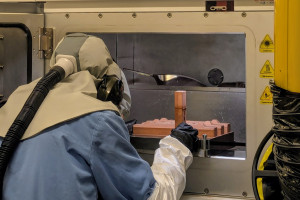
A collaboration between DRF/IRFM and DES/LITEN has produced models of copper-alloy plasma-facing components (PFCs) using additive manufacturing. The technologies used are laser fusion on a powder bed and consolidation of the assembly by hot isostatic compression. These innovative components have already withstood heat fluxes of up to 25MW/m², opening up attractive prospects for future fusion power plants.
Since 2021, as part of the EUROfusion consortium of laboratories, CEA has been developing an innovative concept of plasma-facing components for a future tungsten divertor for the JT-60SA tokamak. This concept will be able to withstand higher heat fluxes than those supported by current designs, while offering competitive manufacturing costs in relation to the performance achieved.
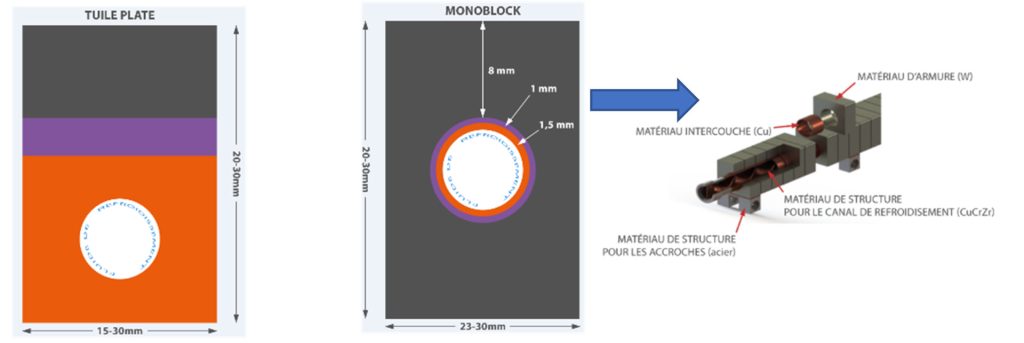
Currently, the divertor components of the actively cooled tokamaks WEST (France), KSTAR (Korea) and EAST (China) can withstand heat fluxes of 10 MW/m² in steady state and 20 MW/m² during transient excursions. These components are based on the use of plasma-facing tungsten, in monoblock or tile form, assembled on a copper alloy (CuCrZr) heat sink into which a cooling channel is inserted (Figure 1). CuCrZr is chosen for its high thermal conductivity and good mechanical properties
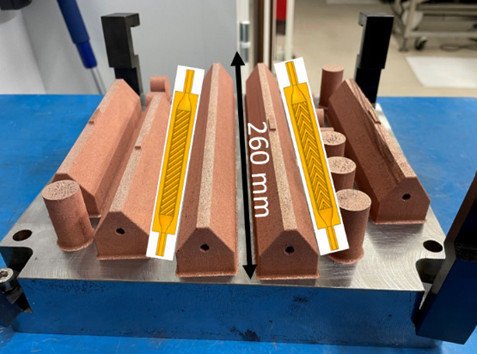
The CEA project explored alternative concepts for improving heat exchange in the cooling channel, with the aim of producing a final component with a tungsten cover in the form of a flat tile (Figure 1), which is easier to manufacture. The choice fell on geometries inspired by the HyperVapotron [2,3], “diagonal” and “chevron” [4,5], which had to be adapted to the constraints of powder laser fusion manufacturing (printing angles, minimum material thicknesses, etc.). CFD (Computational Fluid Dynamic) calculations were used to define the geometries of the exchange promoters. These CuCrZr models were then manufactured at LITEN (Figure 2). A major constraint of additive manufacturing is the residual post-printing porosity, which has a major impact on the heat extraction capacity of the components manufactured by this technique, as well as on their mechanical properties. To close these porosities, a hot isostatic pressing (HIP) treatment was applied. Density was increased from 98.8% to 99.8%. The heat extraction capacity of the manufactured mock-ups was tested up to 25 MW/m² on the HADES high-flux test facility (DRF/IRFM). No visual damage was observed, demonstrating the excellent performance of this concept
These studies will be followed by fatigue testing as part of EUROfusion, and simulation and numerical optimization of cooling circuits as part of the “Enchaine” project, supported by CEA’s Transverse Competence Program. Then, as part of EUROfusion, complete mock-ups (tungsten and CuCrZr) will be manufactured and tested to study the impact of the overall manufacturing process on component behavior.
[2] S. Antusch, A. Klein, S. Baumgärtner, C. Bonnekoh, B. Böswirth, D. Dorow-Gerspach, S. Dietrich, M. Ehrhardt, B.-E. Ghidersa, H. Greuner, M. Guttmann, T. Hanemann, J. Jung, J. Konrad, M. Rieth, Additive manufacturing of novel complex tungsten components via electron beam melting: Basic properties and evaluation of the high heat flux behavior, Nuclear Materials and Energy 39 (2024) 101683.
[3] J. Cao, S. Qin, Q. Wang, X. Chen, X. Feng, Reliability research of hypervapotron under steady-state thermal load, Fusion Engineering and Design 180 (2022) 113191.
[4] J.H. Lim, M. and Park, Effect of Hypervapotron Fin Angle on Subcooled Flow Boiling Heat Transfer Performance Under One-Side High-Heat Load Condition, Fusion Science and Technology 78 (2022) 395-413.
[5] N. Kaewchoothong, K. Maliwan, K. Takeishi, C. Nuntadusit, Effect of inclined ribs on heat transfer coefficient in stationary square channel, Theoretical and Applied Mechanics Letters 7 (2017) 344-350. https://doi.org/10.1016/j.taml.2017.09.013.