

Après près de trois mois d’expériences, la campagne C13 menée sur WEST s’est achevée avec succès, aboutissant à la première observation de plasmas en mode H avec des Edge Localized Modes (ELMs). Cette avancée constitue une étape importante dans la préparation de scénarios de plasma pertinents pour ITER et les futures centrales à fusion.
Pendant près de trois mois, des scientifiques, des ingénieurs, des techniciens et des opérateurs du CEA de Cadarache, en collaboration avec de nombreux partenaires internationaux, ont mené un programme expérimental ambitieux sur le tokamak WEST. La campagne C13 a abordé plusieurs défis scientifiques et technologiques majeurs liés à la fusion par confinement magnétique, allant du comportement des composants en contact avec le plasma à des scénarios avancés de plasma.
La campagne a permis d’étudier les interactions entre le plasma et les parois en tungstène, le chauffage par radiofréquence, les flux thermiques sur les composants en contact avec le plasma, les processus d’érosion, le bilan de puissance et les diagnostics du plasma. Ces expériences ont généré un ensemble de données riche qui soutiendra le développement de modèles prédictifs et contribuera à la préparation de l’exploitation d’ITER.
La campagne s’est conclue par un résultat particulièrement significatif : pour la première fois, WEST a produit des plasmas en mode H accompagnés de Edge Localized Modes (ELMs). Le mode H est le régime de fonctionnement à haut confinement que ITER devrait utiliser pour atteindre ses objectifs de performance en matière de fusion. Tout en offrant un confinement amélioré du plasma, ce régime s’accompagne d’ELMs, des salves d’énergie et de particules libérées au bord du plasma, qui peuvent imposer de lourdes charges thermiques aux composants en contact avec le plasma.
L’obtention de ce régime de fonctionnement sur WEST offre donc une occasion unique d’étudier les interactions plasma-paroi dans des conditions plus proches de celles prévues pour ITER. Cette avancée ouvre la voie à l’un des piliers du programme scientifique de WEST : tester les composants du divertor d’ITER face à des flux thermiques transitoires sur de longues durées, dans un environnement au tungstène similaire à celui d’ITER. Au cours des dernières sessions expérimentales, des plasmas en mode H ont été obtenus avec des puissances de séparatrice comprises entre 3 et 3,8 MW et des densités moyennes par ligne allant de 5,4 × 10¹⁹ à 7,2 × 10¹⁹ m⁻³. Les ELMs ont été observés et caractérisés avec succès à l’aide de plusieurs diagnostics complémentaires, notamment l’interférométrie, les sondes de Langmuir et des caméras rapides dans le visible et l’infrarouge.
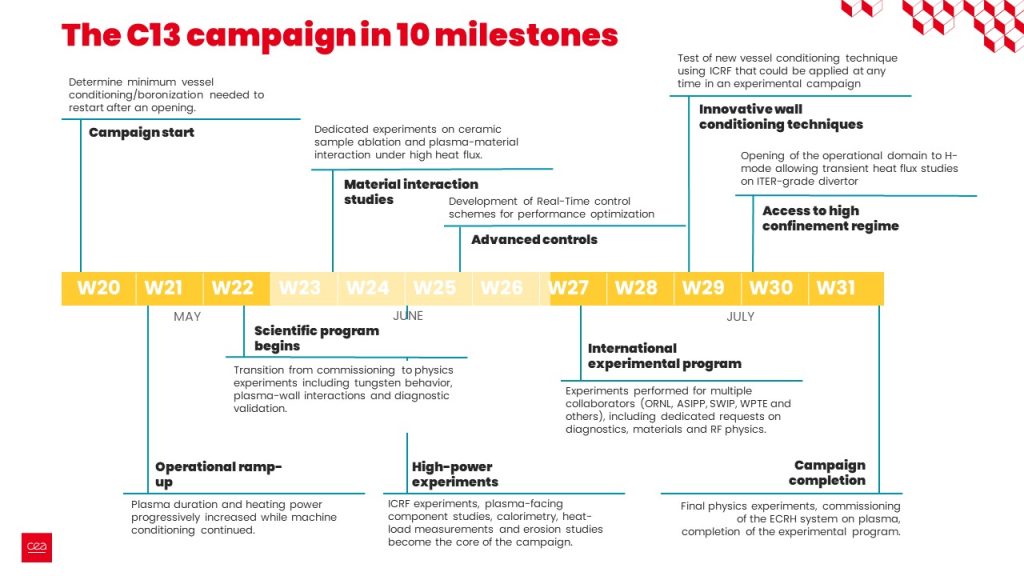
Cette étape importante fait suite à des études approfondies de conditionnement de la machine menées tout au long de la campagne, notamment la détermination du niveau minimal de boronisation des parois nécessaire au redémarrage après une purge, l’utilisation de l’ICRH pour le conditionnement des parois entre les impulsions et l’utilisation de l’ICRH pour la boronisation. Ensemble, ces efforts ont permis à WEST d’atteindre un nouveau domaine opérationnel et de mener à bien son programme scientifique.
Au-delà de cette dernière réussite, cette campagne a démontré la force du programme WEST en tant que plateforme expérimentale internationale réunissant des chercheurs du CEA-IRFM et de laboratoires partenaires du monde entier. Les résultats obtenus au cours de cette campagne vont désormais faire l’objet d’une analyse approfondie et devraient contribuer à de futures publications, à la validation des performances des composants en contact avec le plasma et à la préparation de l’exploitation d’ITER.
Cliquez ici pour consulter le bilan complet de la campagne C13