

Sources of energy
- Growing demand
- And decreasing resources
- Fossil fuels
- Renewable energy
- Nuclear power
- Fusion energy
- Conclusion
Growing demand
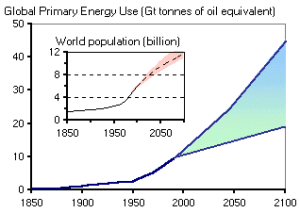
Sources of energy 1 – Growing demand… The progress of humanity cannot be achieved without energy resources. All economic forecasts show that energy requirements are going to keep on rising. This increase, the extent of which varies according to the type of scenario put forward (the level of economic growth and whether environmental constraints are taken into account or not), has two main causes :
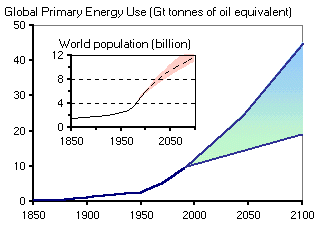
Development in the consumption of primary energy
The present day total world energy consumption is around 8.5 billion oil equivalent metric tonnes (Gtep). Depending on the scenarios, it will be at between 20 and 40 Gtep in 2100. The increase in demand for electricity is likely to be even greater (increase by a factor of 2.5 to 3.5 by the year 2050).
- an increase in the world’s population, which is predicted to rise from 6 billion in 2000 to 10 billion in 2050.
- an increase in the energy requirements of developing countries.
The 21st century will be a century for high energy requirements, both from a quantity (at least double) as a quality point of view (wider access to “commercial” energy).
Decreasing resources
Fossil fuels today provide around 85% of requirements in primary energy and around 2/3 for electricity production. The known reserves of fossil fuels are limited to :
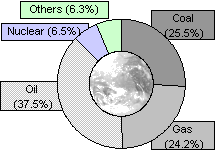
Consumption is posing more and more environmental problems (greenhouse effect) the scale of which is an ever more preoccupying issue .
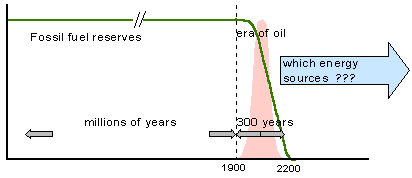
- around 40 years for oil
- around 60 years for gas
- around 220 years for coal
Imaging by magnetic resonance
In this context of limited energy resources and growing environmental constraints new energy scenarios must be put into operation. In simple terms, two major approaches exist :
- the first is based on an extrapolation from the past, showing that there has always existed a dominant emerging source of energy for economic reasons: wood, then coal, and then oil. These scenarios forecast the dominance of gas in the first part of the 21st century, then nuclear energy and then fusion energy beyond 2100.
- the second is based on the simultaneous use of a whole range of energy sources (solar energy, wind power and hydraulics) gradually and partially replacing fossil fuels. The economic aspect here gives up first place to a more ‘environmental’ vision of energy production.
To date no other viable approach has emerged. We may only note that each energy source offers advantages that we will have to learn how to exploit, while also taking care to take all the drawbacks involved in each solution into account.
Fossil fuels
Fossil fuels (coal, oil and gas) have been massively used since the beginning of the industrial era. This use, first focussed on coal then oil, was prior to the current boom in gas. Fossil fuels currently account for more than 85% of primary energy requirements. The energy equivalence of fossil fuels is expressed in the oil equivalent metric tonne retour (tep). 1.5 metric tonnes of coal is needed to obtain as much energy as a metric tonne of oil.
1 metric tonne of oil42 GJ1 tep1 metric tonne of coal29.3 GJ0.69 tep1000 m3 of gas36 GJ0.86 tep1 metric tonne of natural Uranium (water reactor without recycling)420 000 GJ10 000 tep1 metric tonne of fuel D-T (T produce from lithium)378 000 000 GJ9 000 000 tepInventories (relation between proven reserves to date and current production) are estimated at around 40 years for oil, 65 years for gas and 220 years for coal. These deadlines may possibly be extended, but at the price of more expensive extraction and access to sources situated in the frozen areas of Antartica. These resources are patchily spread over the world’s surface. It is estimated, for example that the Middle East will possess 75% of oil resources in 2020. At the same time, 70% of gas reserves will be concentrated in Russia and the Middle East.
The use of fossil fuels leads to the emission of a large quantity of carbon dioxide (CO2) into the atmosphere, which contributes to an increase in the greenhouse effect. Better management of combustion techniques and the use of gas may reduce emissions but will never completely reduce the output (in contrast with renewable power or nuclear power).
Coal- Relatively high reserves
- transport difficult across wide distances
- atmospheric pollution
- output of CO2
- transportable
- limited reserves in specific geographical locations
- atmospheric pollution
- output of CO2
- transportable
- lower production of CO2
- limited reserves in specific geographical locations
- In unrefined form, ten times more dangerous to the greenhouse effect than CO2
Renewable energies
Man has been using renewable sources of energy for thousands of years: wood, horsepower and waterfalls or wind for mechanical applications. In the last 200 years they have been replaced by the use of fossil fuels, which are more suitable for industrial developments. Renewable sources of energy are characterised by low energy density and variable availability.
Hydro-electric energy is the most used of the renewable energy sources. It supplies 3% of worldwide primary energy consumption and about 18% of electrical consumption. It is estimated that to date 15% (2300 TWh/yr) of the technically exploitable potential (around 15 000 TWh/yr) is being used, but the situation is full of contrasts from one country to another. For example, France and Switzerland have exploited 90% of possible sites, whereas Asia and South America exploit less than 20% of their hydraulic potential.
The energy of the oceans is harnessed in various forms: tidal power due to the attraction of the moon, wave power and heat power due to the difference in temperature between the surface and the deep. The two other forms are difficult to exploit at a reasonable cost. The real technical potential of tidal power is estimated at 500 000 GWh/yr (taking into account availability of installations due to the tidal cycle). Technical feasibility has been proven, in particular thanks to the La Rance tidal power station (240 MW installed, 500 GWe.h over a year).
Solar received outside the atmosphere is around 5.5 1024 J (average flow around 1.4 kW/m2). About 30% is reflected into space, 25% is used for the evaporation and precipitation cycle of water and photosynthesis and around 45% is absorbed, and then transformed into heat by the air, the continents and the oceans. This represents around 6000 times world primary energy consumption. The main difficulties in exploiting solar energy rely, on the one hand on considerable variations in weather (daily and annual cycle) requiring storage, and on the other hand low energy density.
Direct conversion of solar energy into electrical energy is possible via photovoltaic conversion. Cell manufacture remains costly, and very energy-consuming. Typical yield of a photovoltaic cell is around 12-13%. World annual electrical production is about 260 kW.h/m²; in one particularly favourable locatio (source World Energy Council).
The production of electricity may be achieved through concepts concentrating the sun’s rays onto a boiler. Experimental power stations have been built (e.g. Themis in the Pyrenees, 2.5 MW) to validate the main technical options but have not led to the construction of stations with greater power, on account of the high kWh cost.
Finally, the use of solar energy may be possible for systems that act as a complement to the heating of a private house (black solar sensor).
Wind power has been used since antiquity (windmills, sails on boats). The main handicap of this form of energy is its great variability (direction, speed, night or day, season). The world wind power market is currently in a period of great development. Forecasts indicate that soon the power installed worldwide will be multiplied by 5 (7200 MW installed to date). Wind turbines may be divided into two main families: vertical axis wind turbines, not requiring any guiding device, but complex and unusual and horizontal axis wind turbines, operating into the wind and therefore requiring a guidance system. These are the most common. A typical 600 kW wind turbine has a rotor of about 45 m. They start to produce electricity from a wind of 13 km/h and must be uncoupled in winds over 90 km/h to avoid damage. A site with an average speed higher than 27 km/h may be considered as sufficient (mainly in coastal areas). Surface area is great(20 kWh/m© &Mac247; /yr) even if effectively used surface areas represent less than 1% of the total area. The “offshore” wind turbine offers considerable potential, but installation and running costs are higher than on land sites. In France, the EOLE 2005 programme is set for a wind turbine potential of 250 to 500 MW by the deadline of 2005.
Hydro-electric- high development potential
- watercourse regulation tools
- no pollution or output of greenhouse gases
- controlled technology
- adaptation finely tuned to possible network demand
- limited geographically
- high initial investment
- environmental aspect (destruction of habitat, modification of watercourses and so on)
- no pollution or output of greenhouse gases
- controlled technology
- few suitable sites
- availability linked to the tidal cycle (≤25%)
- environmental aspect (destruction of habitat, modification of watercourses and so on)
- high development potential
- reliability and modularity
- no pollution or greenhouse gas output in operation
- large surface area used
- low yield
- energy storage necessary
- costly manufacture
- no pollution or output of greenhouse gases
- controlled technology
- large surface area used
- limited land sites
- great variation in resource
- visual, noise and biological environment impact (birds)
Nuclear power
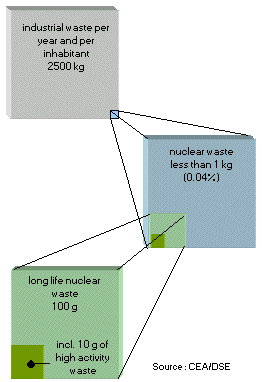
Nuclear energy accounts for 6-7% of world energy production and accounts for more than 20% of electricity supply. Nuclear energy is a very dense form of energy (1 kg of Uranium used in a water reactor is the energy equivalent of 10 metric tonnes of oil, 60 reactors supply 80% of the electricity supply in France) and is well suited for the production of energy on a large scale. Most installations use the ” open cycle “, i.e. without reuse or recycling of materials used in spent fuel. The result is that less than 1% of the energy potentially contained in the fuel is used. Uranium reserves are like those of gas, therefore about 40 years (resources guaranteed at ≤80$ per kilo of uranium). The use of so-called “fast neutron reactors” helps extract around 100 times more energy from natural uranium than by conventional methods, thus postponing the moment that resources will run out in terms of several millenniums. This is a more complex technology, but has been proven to be feasible.
- no pollution nor release of greenhouse gases
- suitable for large scale production
- Waste management over long periods
- acceptance by the general public
- no passive safety
Energy from fusion
Fusion is quite another form of nuclear energy. It includes all the advantages of “conventional” nuclear power (energy density and no operating pollution) while at the same time aiming at the reduction and even the elimination of its drawbacks (no long term waste, intrinsic safety and abundant fuel).
Fusion- no pollution nor release of greenhouse gases
- suitable for large scale production
- intrinsic safety (no risk of runaway reaction)
- fuel is abundant and geographically well spread out
- no waste requiring long-term storage
- feasibility remains to be proven
- concerns the long term (2050)
- high investment cost
- complex technology
Conclusion
Energy production based on the use of fossil fuels will become more and more difficult on account of raw materials themselves running out and the ecological consequences of this type of production. There is absolutely no doubt that renewable energy has a considerable development potential, above all in a world where environmental considerations are taking on greater and greater importance. This form of energy has its pros and cons, and it would not be very realistic to imagine all energy limited to renewable energy on its own. It is obvious that the different energy sources, some suitable to a decentralised electricity market and others more suitable for centralised production in modern high population density areas, complement each other. To be viable, these energy forms should naturally satisfy economic requirements but also take into account environmental demands, operating safety and availability of resources. Energy from fusion, with its feasibility as yet to be proven, meets all these requirements.
For further information :- World Energy Council (CME, WEC) : resources, scenarios, greenhouse effect and so on.
- International Energy Agency (IEA)
- BP statistical review of world energy