Introduction
- Diversifying energy sources
- From renewable to nuclear power
- Fusion reactions
- From the stars to the Earth
- Confinement and magnetic bottles
- The creation of plasma current
- Stabilising plasma
- Heating the plasma
- The main results
- From experimental devices to a reactor
Diversifying energy sources
In 2050 energy consumption could reach two or three times current consumption (energy sources). The fact that fossil fuels are running out, and that it is difficult to adapt renewable energy sources to centralised energy production that is capable of providing for densely populated areas or countries, make the development of new energy sources indispensable. These new forms of energy should obviously meet economic requirements but also take into account environment, operational safety and resource availability requirements. Energy from fusion meets all these requirements.
From renewable to nuclear power
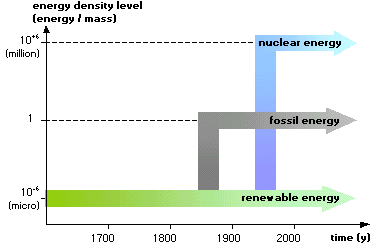
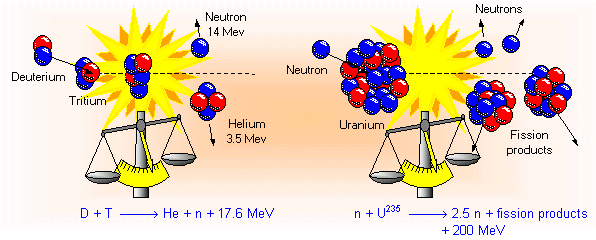
To produce energy, it is necessary to carry out a transformation in which, between the initial and final state, a small proportion of the body mass involved disappears. This mass defect may then be found in the form of energy through the well-known formula E=mc2, where E is the energy produced, m the mass that has disappeared and c the speed of light. Two main types of nuclear reaction, which lower mass and therefore release energy, are possible:
• From joining very light atomic nuclei (examples; deuterium and tritium) to build heavier atoms through the process called fusion.
• From splitting the nucleus of a sufficiently heavy atom (such as the uranium atom) to make lighter atoms, through the process called fission.
Fusion reactions
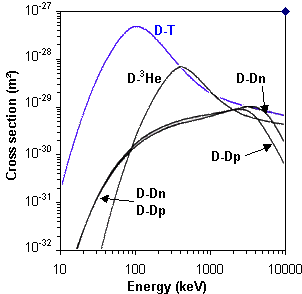
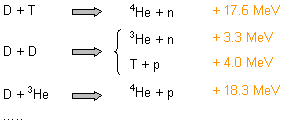
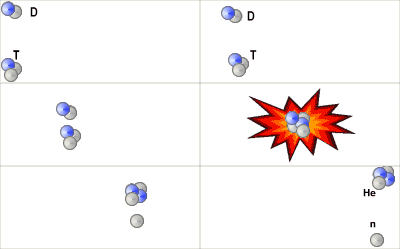
The most accessible fusion reaction is the reaction involving deuterium and tritium. It is on this reaction that research on controlled fusion is conducted.
From the stars to the Earth
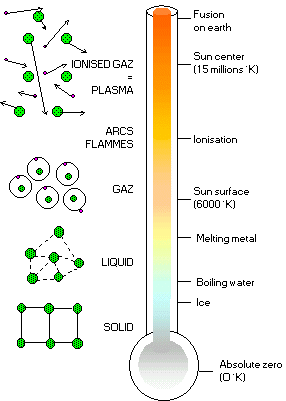
Fusion is the source of energy in the sun and other stars. A star starts to shine when, under the force of gravity, the matter in its very heart attains sufficiently high densities and temperatures to set off thermonuclear reactions, which then release energy. Plasma’s tendency of dispersing, and therefore cooling down, is balanced out by gravitational force.
On Earth, gravitational confinement is impossible. Two paths have been studied to reproduce these reactions: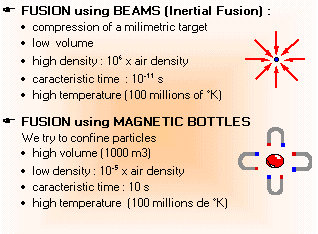
• trapping and maintaining a plasma at very high temperature. This plasma is confined in an intangible torus-shaped bottle created by magnetic fields, described as magnetic confinement.
Confinement and magnetic bottles
In order for the fuel in the form of plasma to produce enough thermonuclear reaction, it must be maintained in a limited volume and kept away from any structural material in order to maintain its high temperature. This is called confinement.
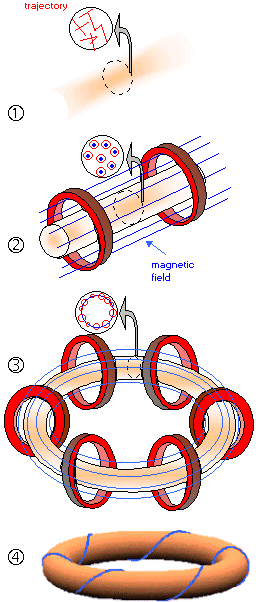
As the plasma is made up of charged particles, the magnetic fields may act on them. If this same plasma is bathed in a rectilinear magnetic field (picture 2), the particles wind around the field lines and will no longer touch the side walls.
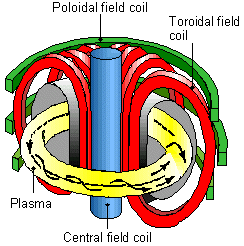
So as to avoid losses from the edges, we close off the magnetic bottle by creating a torus (picture 3). The magnetic field thus created by a series of magnets surrounding the plasma is called a toroidal magnetic field. The magnets generating this field are the toroidal magnets.
Here is shown that confinement is not quite enough and to minimise particle leakage even more, the field lines must be helicoidal (picture 4). This is achieved by adding another magnetic field to the toroidal field, which is perpendicular to it (the poloidal field). The method used to produce these helicoidal field lines has given birth to two types of machine:
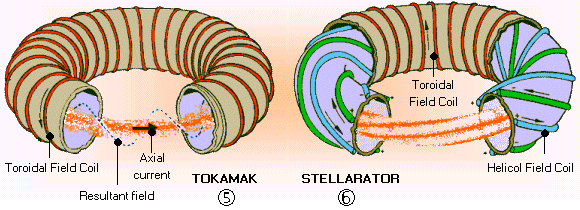
In a « tokamak », an assembly of coils produces a magnetic field in the direction of the torus, to which is added the magnetic field created by an intense axial current flowing in the plasma itself. The two fields generate the helicoidal structure of the field lines (picture 5). This configuration has made considerable progress since its invention in the 1960s by Russian researchers. This is currently the path of research that is being studied the most (an example of a tokamak : Tore Supra)
• In a « stellarator », magnetic configuration is entirely based on currents flowing in helicoidal coils (picture 6).
The creation of plasma current
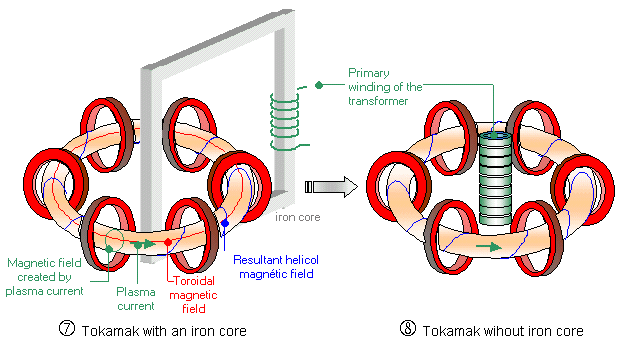
The basic means of producing this current consists in generating it by induction. We place a coil made up of horizontal layers in the centre of the configuration (the coil is placed in the ” hole” of the torus). Using this coil, and provided that the current is varied, plasma current is created by induction exactly like in an electric transformer (picture 7). This type of operation may take place without an iron core (picture 8).
Stabilising plasma
Heating the plasma
Whatever the way in which the plasma was created inside the confinement structure, it never initially has the temperature required for fusion. Three methods are possible to heat the plasma up:• the current flowing in the plasma is also used to heat the plasma by Joule effect (ohmic heating). The latter is effective up to a temperature around 10 million degrees. Beyond that, plasma resistivity becomes too weak and effectiveness of this method decreases. In a Stellarator, there is no central current and therefore no ohmic heating.
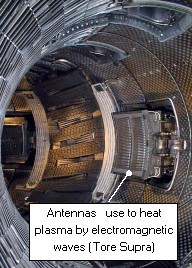
• the plasma may absorb energy from electromagnetic waves at frequencies characteristic of the environment. This heating by electromagnetic waves is transmitted to the plasma by antennas covering part of the confinement area. The choice of frequency defines the type of particles (ions or electrons) that will be heated up and the area through which the wave and thus the heating will be absorbed.
In a thermonuclear fusion reactor by magnetic confinement, the temperature of the plasma may be raised to a suitable level by a combination of the methods presented above. When there are a great number of fusion reactions, the energy carried by the helium nuclei remains confined in the plasma and contributes to heating it. If this contribution becomes equal to the energy lost by the plasma, then the heating methods above are no longer necessary. The thermonuclear plasma is thus self-maintained, and we say that it is in ignition. If we define the amplification factor as being the ratio between the total power generated by the plasma and the heating power injected into the plasma, then this amplification factor is infinite if the plasma is self-maintained. When this factor is equal to one, the plasma supplies as much energy as is injected into it. This last condition is called “break even”. The European tokamak JET has achieved plasmas close to “break even”.
The above animation shows plasma start-up sequences
The main results
Since the arrival of the tokamaks around 1970, plasma fusion power generated by various installations throughout the world has increased by 10,000 million. Many significant results have been obtained in all fields, whether in physics or in the technologies used.
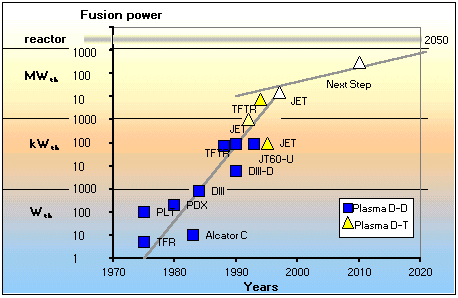
The progress in fusion power through the years
If we only look at the main results they are: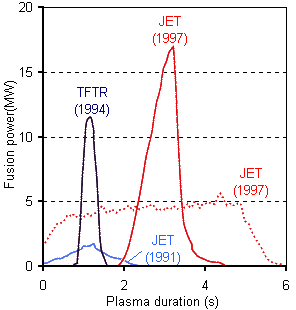
• high power plasmas carried out in 1997 in the European installation JET
• plasmas of a duration of 6 minutes 30 secondes achieved in Tore Supra on december 2003.
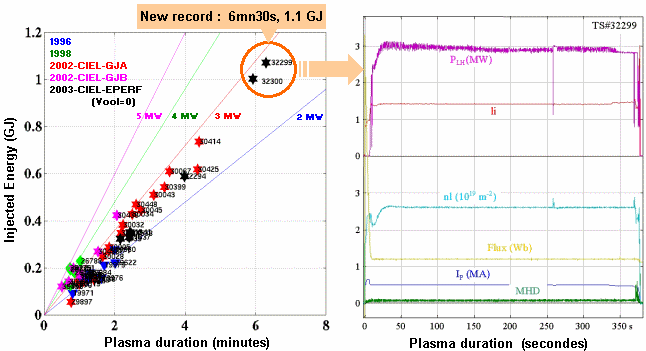
To obtain high performance plasma, it must meet criteria of density (there must be enough nuclei) and of temperature (these nuclei must be at temperatures of several million degrees). The energy carried by the helium nuclei must also remain confined in the plasma for a sufficient time. The period during which the energy stays confined inside the plasma is called the ” energy confinement time ” and this varies according to the square of the major radius of the plasma. This size effect is one of the (intrinsic) features of fusion installations. High performance plasmas are obtained in large-scale installations
The criteria above have been obtained independently for density, temperature and confinement time in the various current experimental installations. The community of researchers and engineers involved in studies on controlled magnetic fusion is now ready to take another step: demonstrate control of sustained combustion of deuterium-tritium plasma over long durations. This will be the next step and the main goal of the next international experimental machine (ITER).
From experimental devices to a reactor
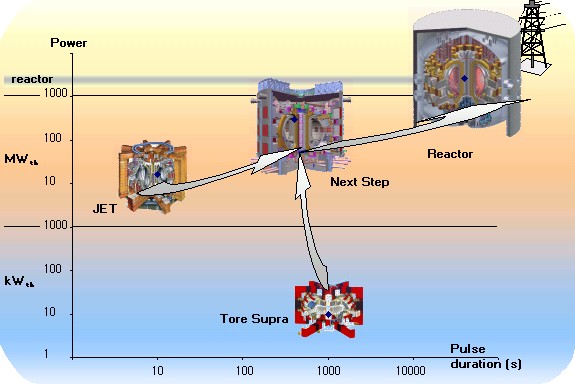
For a long time the Fusion community has attempted to define what the future current generating fusion reactor might be like. We thus have regularly updated studies, which set out the outlines and sometimes the details of what a fusion reactor could be. In addition to these forecasts, we should mention the detailed engineering studies performed in the ITER project, which, although not totally representative, have, all the same, precisely defined most of the main components of the reactor. The diagram of the principle of the electro-generating reactor is shown below.
The deuterium-tritium fuel mixture is injected (1) into a chamber, where, thanks to a system of confinement it goes into a plasma state and burns (2). In doing so, the reactor produces ash (helium atoms) and energy in the form of fast particles or radiance (3). The energy produced in the form of charged particles and radiance, is absorbed in a special component, the “first wall” which, as its name illustrates, is the first material element encountered by the plasma. The energy, which appears in the form of kinetic energy in neutrons, is, for its part, converted into heat in the breeding blanket (4) : which is the element beyond the first wall, but nevertheless inside the vacuum chamber. The vacuum chamber itself is the component enclosing the area where the fusion reaction takes place. The first wall, blanket and vacuum chamber are obviously cooled down by a heat extraction system. The heat is used to produce steam and supply a conventional turbine and alternator electricity producing system (5).
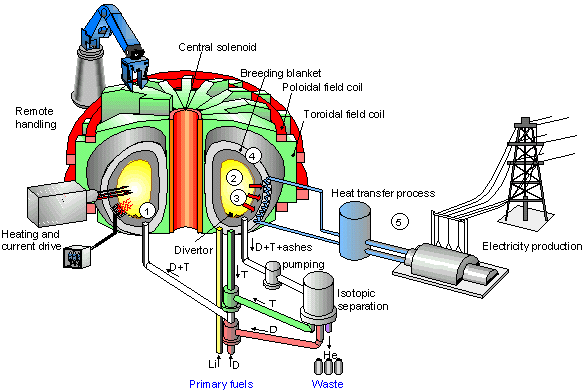
If we exclude all the components dealing with energy production (breeding blanket for example), a reactor will look much like what an experimental installation of the next generation like ITER will be. This future installation will validate feasibility of energy production through thermonuclear fusion not only as regards physical principles but also as regards most of the main components within a reactor (huge superconducting magnetic coils for example). Performance in terms of plasma confinement required from an electricity generating reactor are only 4 or 5 times higher than the nominal performance of the ITER project. We can reasonably guess that the first electric kW produced by a thermonuclear fusion reactor prototype may see the light of day around 2050 that is to say about a hundred years after the initial research on controlled thermonuclear fusion. A period of a hundred years between the discovery of the concept and final use is not as unusual as that. After all, the discovery of the principle of solar cells goes back to 1839 (A. Becquerel) and the discovery of the principle of the fuel cell goes back to 1839 (W.R. Grove).