

Industrial and scientific spin-offs
Introduction
Although commercial applications of fusion as a source of energy are not forecast to be in operation before the middle of the 21st century, the research programme on controlled fusion has already produced a number of significant scientific, technological and industrial spin-offs. The main reasons for this are the complexity of the subject and the vast palette of skills necessary for its study, as much from a physical point of view as from the point of view of the technologies implemented. The strong interaction between physics and technology is incidentally one of the features of these studies (example: the type of material facing the plasma has a considerable influence on it). This imposes close cooperation between the two fields so that research on fusion has been cutting edge technology from the beginning. The two main categories are:
- direct spin-offs, i.e. industrial participation in research on fusion
- indirect spin-offs, i.e. non-fusion applications of technologies initially developed in the framework of research on fusion
Direct spin-offs: industrial participation in the fusion programme
For a long time, the main role of industry was centred on the manufacture of components or auxiliaries for the experimental fusion installations. Although these activities still exist, they have now extended to include a number of studies in design and expertise, for example, the cost assessments of the ITER project. Industrial partners themselves have taken measures to meet the growing demand for specific design studies, various developmental work, design reviews and even provision of personnel (creation of several European level organisations etc.).
European participation in the ITER project during the detailed engineering phase (1992-1998) was nearly 300 MEuro. Nearly a third of this budget went directly to European industry via design activities (~22 MEuro) and research and development activities including manufacture of specific equipment (~65 MEuro).
Construction and upgrading of experimental fusion installations such as Tore Supra or JET, obviously call for industrial skills on a massive scale. The sums spent on JET in industry (” hi-tech “) contracts since 1978 reached nearly 519 MEuro in 1995. More than 90% of this sum concerned European industry. Figure 1 shows the share of contracts given to industry by JET per main sector.
Figure 1 : ” Hi-tech ” industrial contracts signed by JET (1978-1995)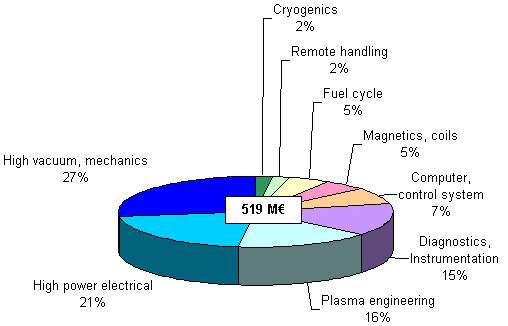
With respect to the research organisations involved in the fusion programme, the expenditure resulting from partnership with industry for the same period is estimated at 318 MEuro. It essentially corresponds to improvements carried out on existing installations. Figure 2 shows two examples of industrial partnerships carried out in the context of Tore Supra.
Figure 2 : Examples of industrial partnership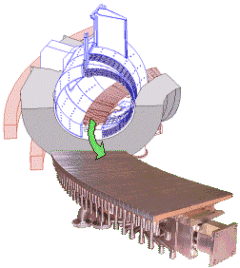
Development of plasma facing components(CEA/Plansee, Plansee-fusion)
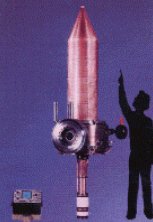
Development of a Gyrotron at 118 GHz (CEA/CRPP/FzK/Thomson)
Indirect spin-offs
There are two facets to the origin of indirect spin-offs from the fusion programme:
- On the one hand, let us remember that plasmas make up nearly 99% of matter in the Universe. A fluorescent tube is a common example of plasma. Studying behaviour in this area has a very wide scope of applications (astrophysics for example).
- On the other hand, design complexity, manufacturing and building fusion installations has led to technology transfer towards industry as well as the development of new industrial processes with applications going well beyond the framework of the fusion programme. Here are a few examples:
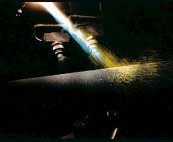
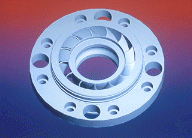
Coating techniques by plasma spraying have applications ranging from the production of hard-wearing resistant coatings (for example drill bits) to the anti-corrosion treatment of tools and various other type of equipment.

Astrophysics : the behaviour of a plasma is governed by unusual laws of physics. It is an ideal environment for the study of turbulence, chaos, complex phenomena and non-linear dynamics. These subjects have very wide ranges of application. Understanding the sun and its effects on the Earth is one good example. Studies carried out in fusion installations on the interaction of rapid particles have direct applications on our understanding of magnetic storms induced by solar winds as a result of a solar eruption.