

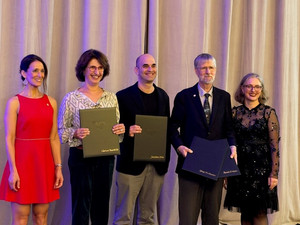
At the annual conference of the Plasma Physics Division of the American Physical Society in Chicago on November 4, 2026, Clarisse Bourdelle, a researcher at CEA-IRFM, received the 2026 Landau-Spitzer Prize along with three other American and European researchers. This award recognizes their work on the development of fast models of turbulent transport in tokamak plasmas.
The Landau-Spitzer Prize in Plasma Physics is awarded to an individual or a group of researchers for outstanding theoretical, experimental, or technical contributions in the field of plasma physics, as well as for their role in strengthening collaboration and unity between Europe and the United States through joint research or work that advances knowledge in a way that uniquely benefits both communities. This biennial award is jointly sponsored by the plasma physics divisions of the American Physical Society (APS) and the European Physical Society (EPS).
The 2026 Landau-Spitzer Prize was awarded at the annual conference of the American Physical Society’s Plasma Physics Division in Chicago on November 4, 2026, at
- Clarisse Bourdelle (IRFM, CEA Cadarache, France)
- Jonathan Citrin (Google DeepMind, UK)
- Gary Staebler (Oak Ridge National Laboratory, USA)
- Ronald Waltz (General Atomics, USA)
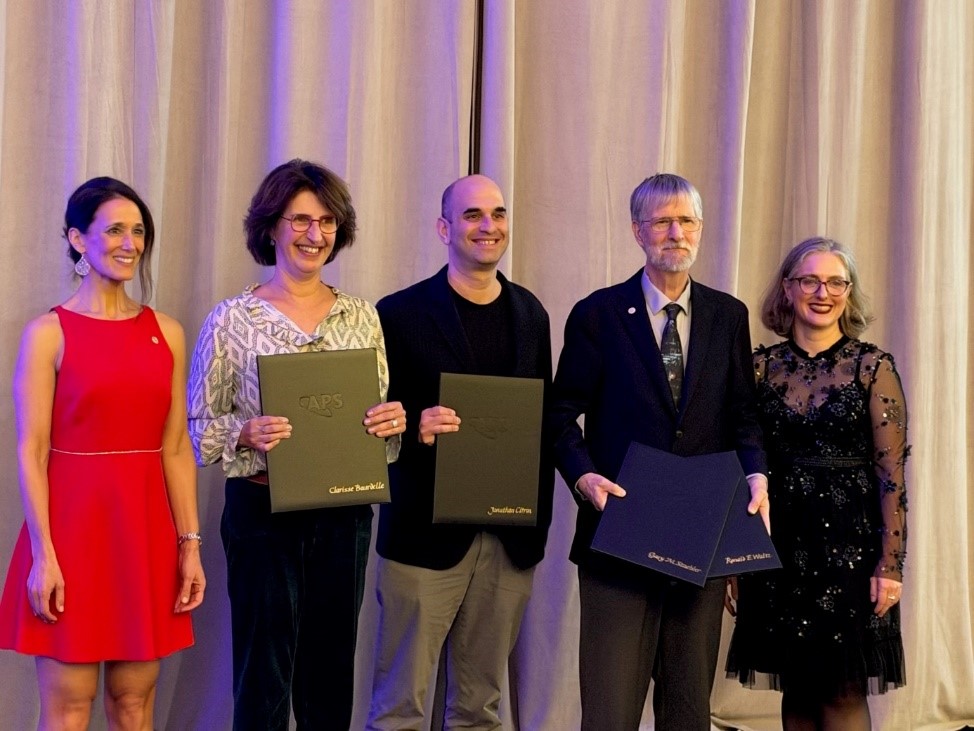
Presentation of the 2026 Landau-Spitzer Prize with three of the laureates in attendance in Chicago on November 4, 2026 (Clarisse Bourdelle, Jonathan Citrin, and Gary Staebler)
This year’s award recognizes “advances in the development of models capable of providing accurate and rapid predictions of turbulent transport in tokamak plasmas, the result of a collaboration spanning more than a decade covering fundamental quasi-linear gyrokinetic theory, experimental validation on several tokamaks, and machine learning methodologies.”
This team of researchers has made advanced simplified models of turbulent transport available to the scientific community for use in tokamak plasma simulations. These simplified models, known as quasi-linear models, have been validated against higher-fidelity nonlinear codes. This work was conducted on both sides of the Atlantic—with the development of the TGLF code in the United States and the QuaLiKiz code in Europe—and has always been carried out collaboratively. A journal article authored by the four laureates was recently published in *Nuclear Fusion*
This work has not only advanced our understanding of plasma physics but, when coupled with other models (a process known as “integrated modeling”), it also improves the ability to decipher the complex nonlinear loops at work in tokamak plasmas. The close collaboration and mutual trust between the developers of TGLF and QuaLiKiz played a decisive role in the validation process conducted on both sides of the Atlantic (on the DIII-D, Alcator C-Mod, ASDEX Upgrade, JET, WEST, and TCV).
TGLF and QuaLiKiz, along with their neural network-accelerated versions, are now used in virtually all tokamak design and plasma scenario development activities worldwide (ITER, JT-60SA, DTT, SPARC, etc.). These are the best tools currently available.
Another notable example is their use to optimize the operation of current tokamaks through rapid and reliable predictions. This was the case for preparing WEST’s record 22-minute plasma run and, previously, for accurately predicting fusion power in JET during the preparation of the latest deuterium-tritium campaigns.