

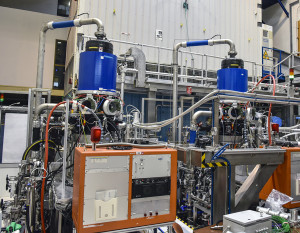
A new milestone has just been reached at WEST: the Electron Cyclotron Resonance Heating (ECRH) system is now operational in plasma with a first gyrotron, paving the way for the injection of 3 MW of ECRH power at 105 GHz.
The first 105 GHz gyrotron was delivered to IRFM in June 2026, after demonstrating its performance on KIT’s FULGOR test bench, delivering 800 kW of power for 60 seconds. After its integration into WEST’s ECRH platform, a series of short-pulse (~15 ms) tests successfully qualified the gyrotron in its final operating environment.
Characterization of the beam at the diamond window exit, along with adjustment of the mirrors in the adapter box between the gyrotron and the transmission line, subsequently validated the injection of microwave power all the way to the antenna. The gyrotron was thus connected to the upper mirror of the ECRH antenna and has been used for the first plasma runs since July 2026.
These initial firings demonstrated the effect of ECRH heating on the plasma (see Figure 1), particularly through ECE measurements, with a trend consistent with the injected power. Specific work on the wave’s polarization also made it possible to optimize wave absorption and reduce the power level detected by the sniffers, which measure a portion of the power not absorbed by the plasma.
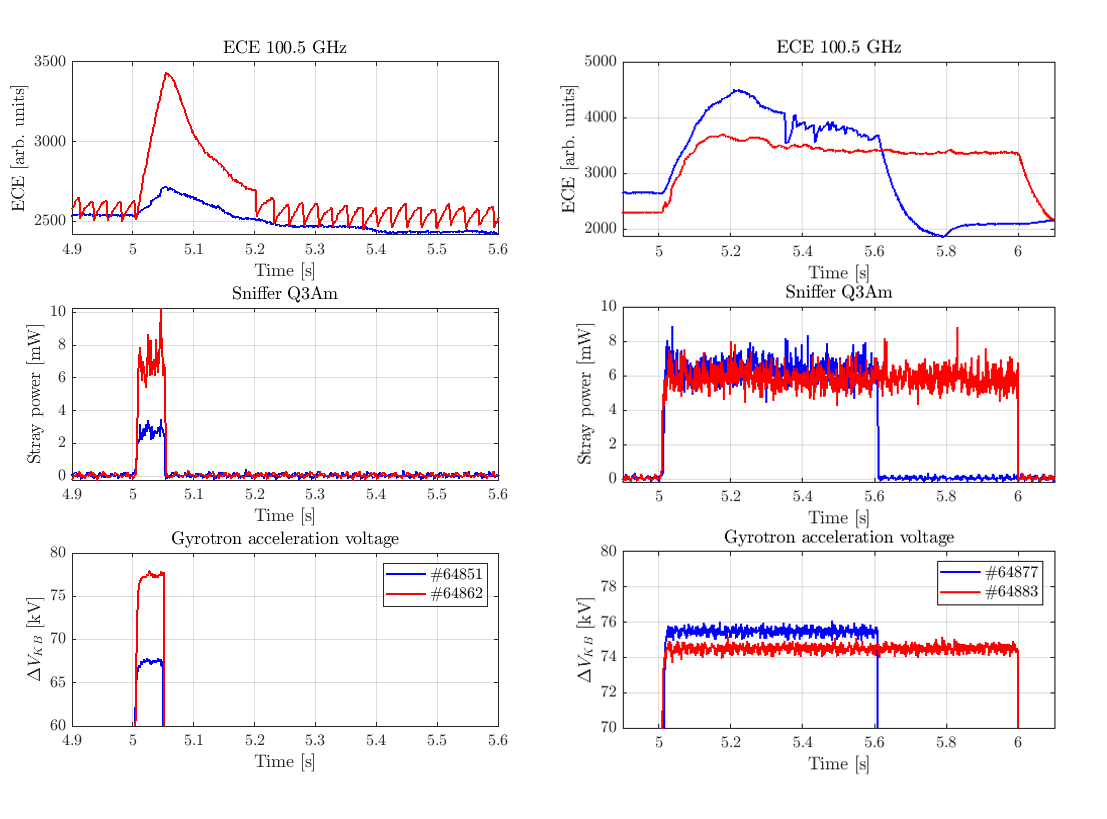
(a) Signal evolution with injected power (red:PECRH = 800 kW, blue:PECRH = 350 kW)
(b) Signal evolution with duration up toPECRH = 1 MW/1 s
The campaign has already achieved pulses at 800 kW for 1 second, marking a first step toward gradually increasing both the power and duration of the pulses. This performance ramp-up continues, with particular attention being paid to controlling outgassing in the transmission line.
At the same time, a second gyrotron has been installed on the WEST platform and is entering its qualification phase. Its integration and commissioning will soon make it possible to have two gyrotrons operating in plasma, a major step toward the goal of
3 MW of ECRH at 105 GHz on WEST (see Figure 2).
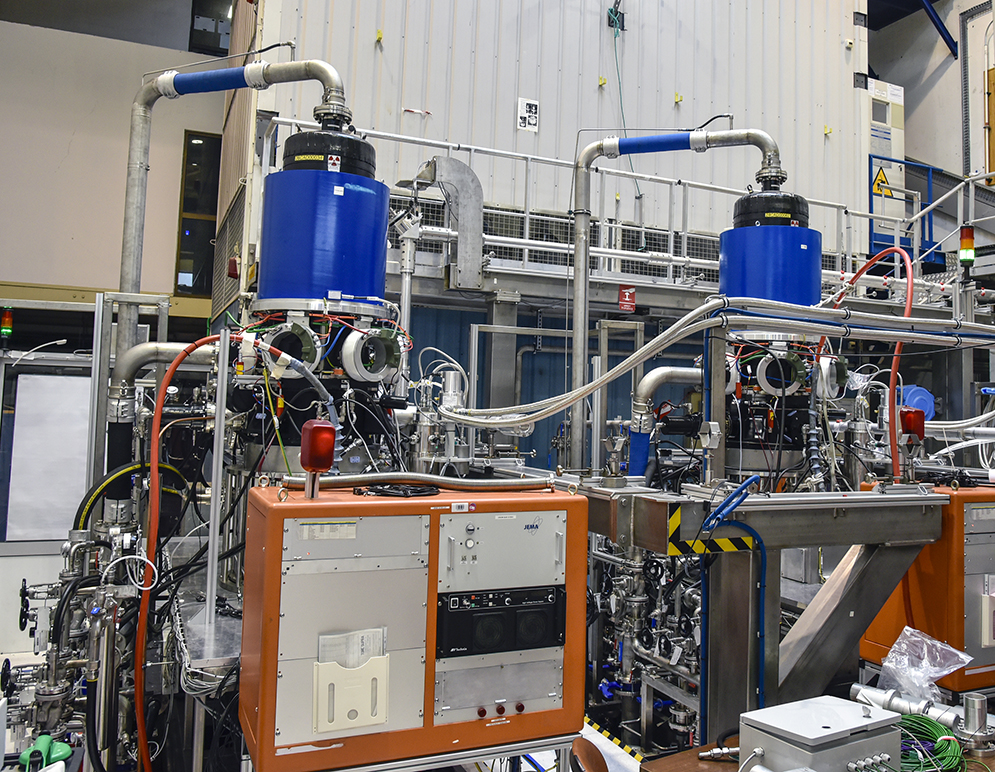
One is operational in plasma, while the other will soon be qualified under RF load
Lena DELPECH