

In a future fusion power plant, the plasma will be heated to temperatures far higher than those found at the Sun’s core. Magnetic fields confine this ultra-hot plasma away from the walls of the vacuum chamber, but at the cost of concentrating the energy that escapes onto an extremely small surface area within the divertor. One of the main challenges of magnetic confinement fusion energy is therefore clear: how can this intense heat be removed without damaging the machine, while preserving the conditions necessary for fusion within the plasma? A new plasma regime, which allows for better distribution of the heat load without degrading plasma conditions, has recently been observed in several tokamaks. A study published in Physical Review Letters, based on advanced simulations of the edge plasma, explains the underlying mechanisms leading to this transition of the plasma into this highly promising new regime.
A radiating screen at the plasma’s periphery
The continuous extraction of power from fusion plasmas is a critical challenge. In tokamak-type fusion facilities, most of the power is emitted by the plasma in the form of high-energy ionized particles directed—via a magnetic configuration known as an X-point—toward a specific component, the divertor. This component is therefore subjected to extreme stress, both thermally and in terms of erosion.
To reduce these stresses, the standard approach is to ensure that the plasma’s periphery dissipates part of its kinetic energy as light before it reaches the material surfaces. To achieve this, a small amount of impurity gas, such as nitrogen or argon, can be injected into the plasma’s periphery. These atoms and ions absorb energy from the plasma and re-emit it as radiation, thereby distributing the power to be extracted over a larger area and significantly reducing the thermal load on the divertor. Unfortunately, these impurity injections generally impair plasma performance and must be carefully optimized to ensure divertor protection without unduly compromising plasma performance.
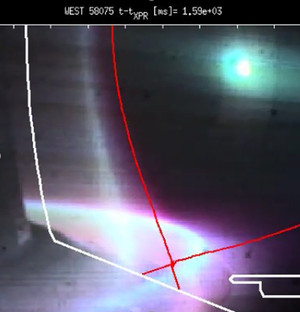
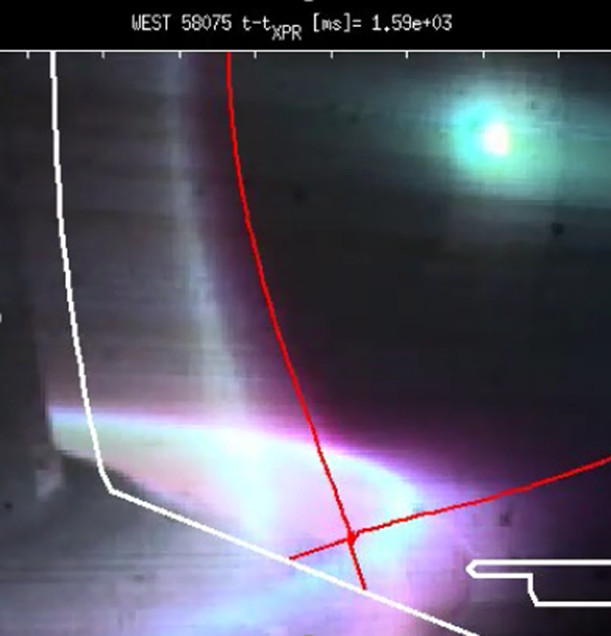
The radiative plasma regime, known as the “X-point radiator (XPR),” has recently been observed in several tokamaks, sparking keen interest as a promising approach to significantly reduce the thermal loads on the divertor. Experiments conducted on the WEST tokamak have demonstrated a particularly interesting and stable implementation of this regime (Photo 1). In this XPR regime, a stable radiation zone forms near the magnetic X-point, between the confined plasma and the divertor components. This toroidal radiation ring acts as a buffer, protecting the components in contact with the plasma while maintaining compatibility with high-performance operation.
A Hidden Transient Mechanism
Although the XPR regime can be stable once established, its formation occurs in a matter of only a few milliseconds. It is therefore difficult to identify the physical mechanism based solely on experiments.
In a new study published in Physical Review Letters
Figure 1: Dynamics of the XPR transition simulated by the SOEDGE-3X code
This transient vortex is not the final state, but rather the path leading to it. As the injected impurity begins to cool the plasma’s periphery, it alters the local electric fields by creating an electrostatic potential well, leading to a temporary circular motion resulting from the competition between a transverse induced drift (known as “ExB”) and an anomalous diffusive flux. This motion promotes the transport of cooler, impurity-rich plasma toward the X-point region, thereby enhancing local radiation. A positive feedback loop then establishes itself: cooling promotes circulation, circulation enhances the accumulation of impurities, and the accumulation of impurities further increases the radiation. Within a few milliseconds, the system reaches a stable radiative state, after which the vortex disappears as cooling spreads around the X-point region and gradually weakens the potential well. As a result, the ExB drift subsides, allowing anomalous diffusion to become the dominant mechanism. The SOLEDGE-3X code incorporates the relevant physical elements—including drifts and diffusion—to accurately reproduce this subtle, self-regulating dynamic interaction.
Why is this important?
The main implication is that the transient vortex provides a more reliable pathway to the XPR regime. Instead of requiring an excessive injection of impurities to create the radiative mantle, the vortex provides an internal transport mechanism that concentrates cooling near the X-point and accelerates the transition to a stable radiative state. This allows the XPR regime to be reached earlier and with a lower impurity level, thereby reducing the risk that radiation will penetrate too deeply into the confined plasma and evolve into instabilities that could lead to its extinction.
This study also explains the hysteresis observed in this regime: once the toroidal radiation ring has formed, fewer impurities are needed to maintain it than to create it. In other words, the plasma retains a “memory” of the transition.
By establishing a link between a rapid experimental transition and a specific physical mechanism, this research points to a promising path for controlling the extraction of radiative power in the plasmas of future fusion power plants.
Reference: