

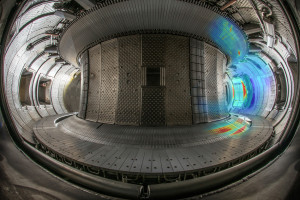
In magnetic fusion devices, the erosion of components by the plasma causes the emission of microparticles, nicknamed UFOs (Unidentified Flying Objects), which, when they enter the plasma, can cause it to suddenly shut down. An automatic detection method using artificial intelligence has been developed to study the conditions under which they appear, their behavior, and their impact on the plasma.
The plasma-facing components of a fusion device are in constant interaction with the plasma. This interaction can cause significant erosion, resulting in the emission of atoms that eventually redeposit on the walls in the form of deposits. Under thermal stress, these deposits can fragment and emit debris—known as UFOs—into the peripheral plasma. When they enter the confined plasma, they cause a sudden radiative cooling that can lead to the complete extinction of the plasma, or a disruption. During the WEST high-fluence campaign in March–April 2023, approximately 35% of the disruptions were attributed to the presence of UFOs.
To identify the emission zones and understand the conditions under which they arise, the CEA-IRFM has developed and deployed UFOund, a tool based on artificial intelligence. Designed using images provided by the 12 infrared cameras of WEST’s wall protection system, it automatically identifies the presence of UFOs in these sequences. UFOund thus goes beyond traditional methods (such as thresholding or image subtraction), which are often rendered ineffective by the complexity and rapid changes in thermal scenes
Another major advantage of UFOund lies in its ability to provide location maps and particle trajectories without requiring additional manual annotations. This automatic segmentation feature saves a considerable amount of time while providing a more precise view of UFO behavior (Figure 1).
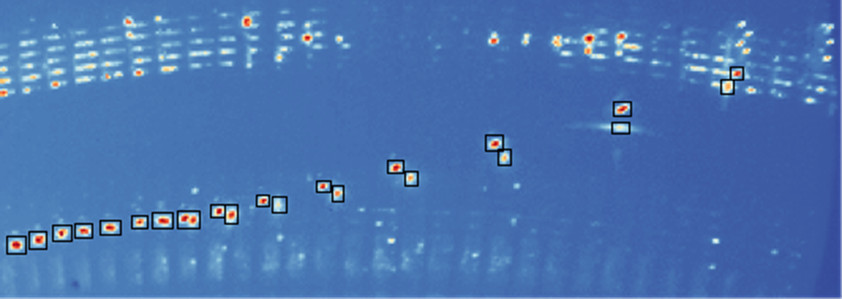
Figure 1: Superimposed infrared images showing a UFO passing through the lower divertor of WEST, moving from left to right in the image, and its reflection on the divertor’s tungsten.
UFOund is integrated into WEST’s post-experiment plasma analysis pipeline. As soon as a plasma run ends, all infrared views are analyzed within a few minutes, and the detected UFOs are stored in a dedicated database. An interactive dashboard allows those responsible for first-wall protection in the control room to view the identified UFOs and quickly assess their role in any potential disruption. The time savings and detection accuracy provided by UFOund make it an indispensable tool for determining whether plasma conditions can be repeated without modification or whether they require adjustments.
UFOund offers two key benefits: first, it speeds up decision-making between experiments by automating the previously time-consuming task of searching through images; and second, it enhances machine protection by providing systematic and reliable monitoring of UFOs. Finally, UFOs detected during experimental campaigns are stored in a dedicated database. This database serves as a reference for their analysis and for the development of other methods enabling the physical characterization of these UFOs. Beyond WEST, this approach opens up new possibilities for future fusion machines such as ITER, where the complexity and volume of data will require such automated analysis tools.