

The current reference material for plasma-facing components in ITER and fusion power plant projects is tungsten. However, when subjected to the extreme heat fluxes of these machines, its mechanical properties deteriorate. The combination of tungsten and diamond—which has very high thermal conductivity—is an approach being developed at CEA-IRFM to create a composite that can combine the advantages of both tungsten and diamond. A patent has been filed, initial samples have been manufactured, and the first tests have shown promising results.
The armor materials for plasma-facing components currently under consideration for magnetic confinement fusion machines typically involve “high-Z” refractory metals such as tungsten (W)
Carbon, in the form of graphite or fiber-reinforced composites, is no longer considered a plasma-facing material, primarily due to its high tritium retention capacity
For this reason, a tungsten-diamond composite was developed consisting of a millimeter-thick CVD diamond substrate, to ensure rapid and uniform heat distribution at the expected heat flux, with a tungsten coating approximately ten microns thick on its surface to act as protection against erosion.
This material, its applications as armor under high heat flux, and its manufacturing process are now the subject of a patent filed with the National Institute of Industrial Property [WO2026008640A1].
This is the result of a study during which 10×10 mm W-diamond samples were fabricated and tested under high heat flux at the CHAUCOLASE laser station
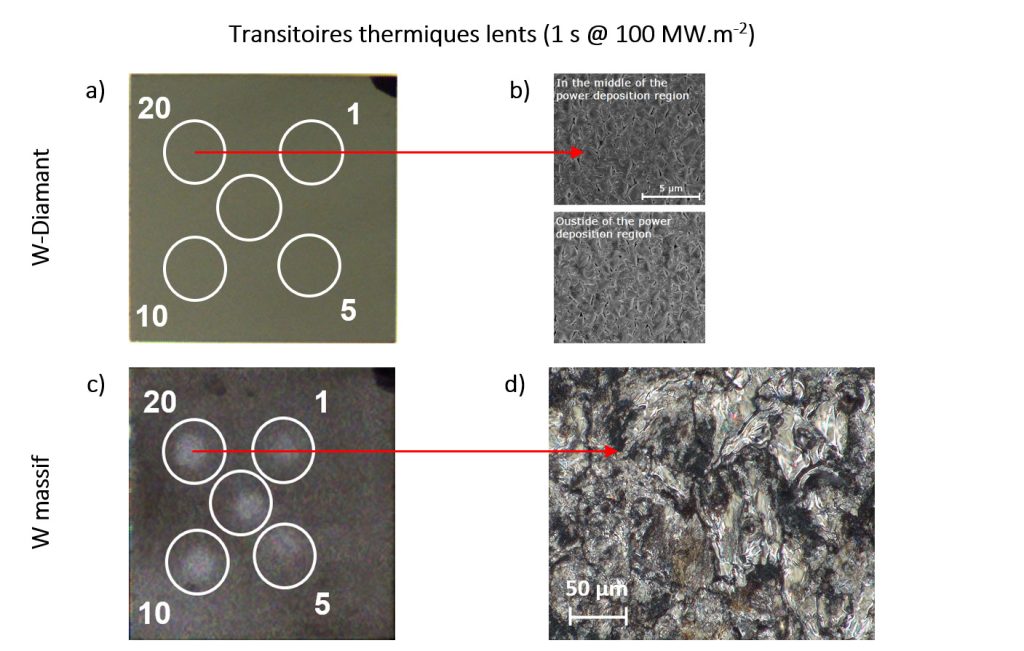
Figure 1:
a) W-diamond sample after 1 to 20 cycles (in the indicated regions) at 1 s at 100 MW·m⁻².
The central region was subjected to a single event of continuous power deposition for 10 s at 100 MW·m⁻².
b) Electron microscope images of the surface in the middle of the power deposition zone (after 20 cycles) and of an unexposed surface.
c) Same as a) for a solid W sample.
d) Optical microscope imaging of a solid W surface subjected to the lowest heat load.
[8] G. de Temmerman et al., Phys. Scr. T138 ( 2009) 014013
[9] D. Kogut et al., Journal of Nuclear Materials 500 (2018) 110–118