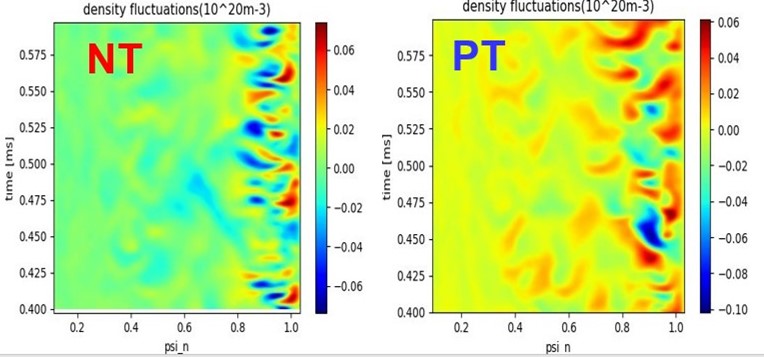
In tokamaks, particular attention has been paid in recent years to plasma configurations with negative triangularity, as opposed to the more traditional positive triangularity. Numerical modeling of experiments conducted on the DIII-D (USA), using the JOREK-GK code, has confirmed a decrease in the overall turbulence level in negative triangularity, resulting in better energy confinement and, consequently, improved plasma performance.
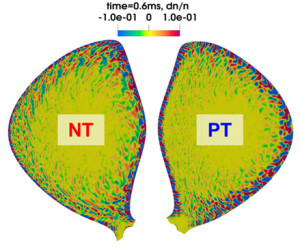
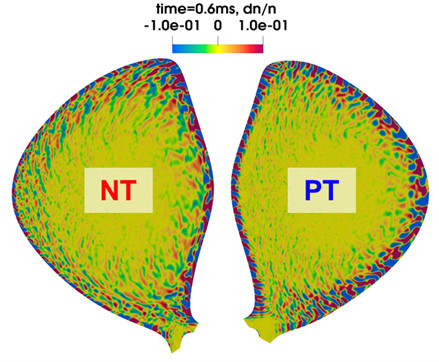
Negative triangularity (NT) is a specific shape of the plasma cross-section in a tokamak-type fusion facility, where the plasma is curved toward the inside of the torus rather than outward. While in most current tokamaks the plasma cross-section has an outward-facing “D” shape (positive triangularity, PT), negative triangularity is characterized by a reversal of this shape (see Figure 1).
Experiments conducted on the TCV (Switzerland) and DIII-D (USA) tokamaks have shown that this geometry can reduce the level of turbulence in the plasma. Less turbulence means that heat is better confined, which is essential for sustaining fusion reactions. This is why the NT configuration is now considered a very promising avenue for future fusion power plants.
Another important advantage of the NT configuration is the potential reduction of edge instabilities, ELMs (“Edge Localized Modes”), sudden bursts of heat and particles that can damage the inner walls. These instabilities are typical of the enhanced confinement mode (H-mode) in plasmas with positive triangularity. Negative triangularity could thus allow for similar performance without these instabilities, which would improve the lifespan of the wall materials and the reliability of the power plant.
However, this approach is still in the research phase. The majority of current tokamaks have in fact been designed around positive triangularity, which maximizes the plasma volume on the high magnetic field side (the toroidal field decreases as 1/R). In recent years, numerous theoretical studies and numerical simulations have been conducted to better understand the effects of negative triangularity in tokamaks.
The results presented in a recent article
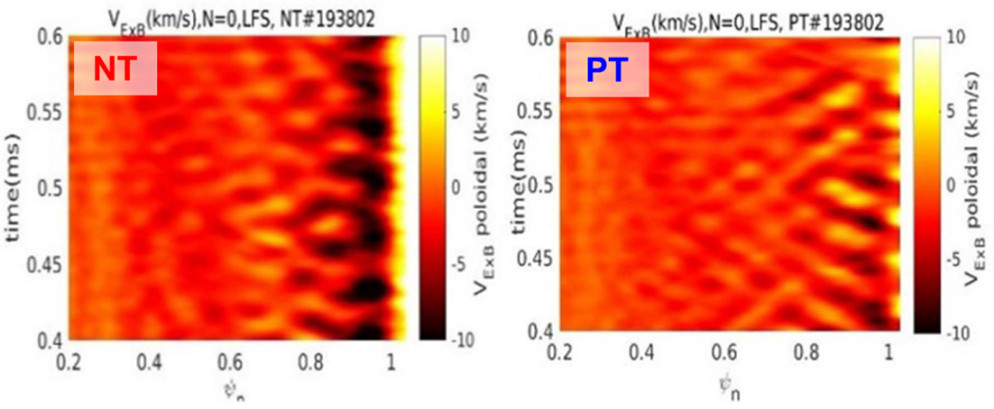
A comparative study between plasmas with negative (NT) and positive (PT) triangularity was conducted for plasmas produced in the DIII-D tokamak, and confirmed that the NT configuration is characterized by reduced heat loss compared to the PT configuration, even when the plasma profiles are identical. This improvement appears to be linked to internal plasma flows, known as “zonal flows,” which are more intense and more sheared in the NT case (Figure 2). These flows help stabilize the turbulence, thereby improving heat confinement. The simulations also showed that density fluctuations in positive-triangularity (PT) plasmas extend over greater distances, a sign of stronger turbulence than in NT plasmas (Figure 3). Both NT and PT configurations follow a similar confinement law, but negative triangularity consistently provides better confinement for the same plasma parameters. This suggests that it could be advantageous for future fusion power plants characterized by good confinement in the absence of ELMs, those instabilities that can damage the walls near the plasma.