

How will the plasma core in future fusion power plants behave? What will be the physical effects of alpha particles—produced directly by fusion reactions—on plasma stability? A new journal article provides a summary of recent research on the interaction between fast particles, the instabilities they can excite, and the nonlinear mechanisms that influence turbulent transport, and consequently the overall performance of fusion plasmas.
In future fusion power plants, the primary fuel will be a mixture of deuterium and tritium. Fusion reactions between these two nuclei produce alpha particles with an energy of 3.5 MeV in the plasma core. This energy is much higher than that of the plasma’s thermal ions, implying a clear separation of energy scales. Under these conditions, which are likely to trigger high-frequency instabilities in a context of high plasma pressure and thus powerful electromagnetic effects, complex multi-scale interactions may arise: they are difficult to predict and potentially detrimental to confinement. While certain effects of the alpha particles generated by fusion reactions have been directly observed in deuterium-tritium campaigns conducted on the European tokamak JET, their low abundance compared to what is expected in future fusion plasmas makes extrapolations difficult. Generally speaking, in current tokamaks, the majority of fast ions are generated by external heating systems, such as, for example, ion cyclotron resonance heating (ICRH) in the WEST tokamak. However, the energies reached by these fast ions are generally lower than those of alpha particles. Consequently, experimental exploration of the nonlinear regimes expected in burning plasmas (self-heating plasmas), in which alpha particle effects dominate, remains very limited.
This research area has seen renewed interest following major discoveries regarding the interaction between fast ions and plasma turbulence. This work is part of a trend that began between 2000 and 2010, when beneficial effects of fast ions on confinement and overall performance were observed in the JET tokamak. Advanced numerical simulations subsequently showed that complex phenomena (involving high-frequency instabilities, on the order of 100 kHz, excited by fast particles) and their nonlinear, multiscale interaction with specific perturbations of the electrostatic field, known as zonal flows, could lead to a significant improvement in core plasma performance. These mechanisms lead in particular to a sharp reduction in turbulence at millimeter scales, characteristic of thermal ions.
Over the past fifteen years, growing interest in the interaction between fast ions and turbulence—and thus in its impact on the confinement properties of the plasma core—has led to numerous experimental, theoretical, and modeling studies. The goal is to understand, quantify, and eventually harness these effects, given their potential importance for improving confinement and accelerating the economic viability of fusion energy. This is precisely the subject of the article coordinated by the CEA/IRFM
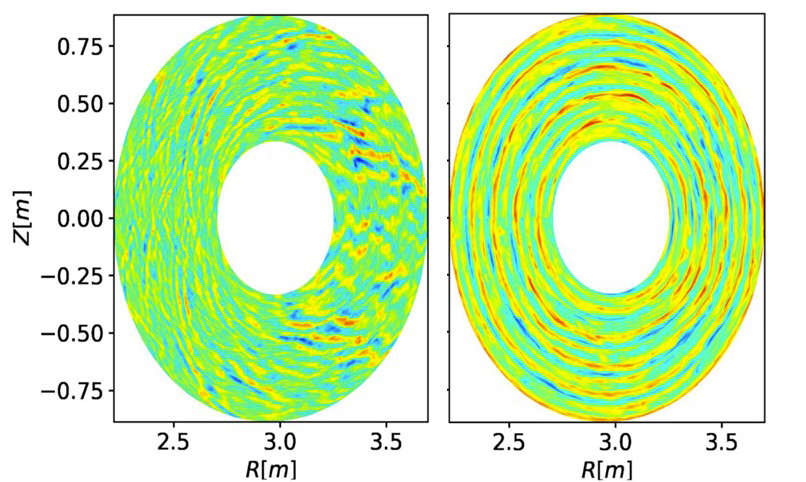
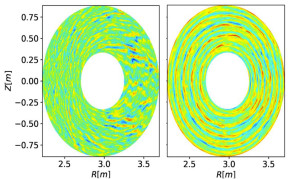
Without fast ions (left), turbulence dominates. With fast ions (right), zonal flows are generated by nonlinear interaction; they are oriented primarily in the poloidal direction and do not induce radial transport, thereby improving confinement.
This mechanism also forms the central focus of an ANR “Young Researchers” project awarded in 2025. This project aims to extend its application to the WEST tokamak in order to seek experimental confirmation in a new plasma regime and to understand in detail all the physical components involved. The goal is to precisely identify the role of each factor in improving confinement: fast ions, alfvenic modes, zonal flows, and turbulence. Ultimately, such an understanding could pave the way for active control of this mechanism, enabling the optimization of plasma confinement and the sustained achievement of higher ion and electron temperatures in future fusion power plants.