

The journal Plasma Physics and Controlled Fusion (PPCF) now publishes “Roadmap” articles, which aim to review the state of the art and define priority areas for research in certain fields. One such article has just been published on the consequences of decoupled electrons, known as “runaways,” in tokamaks, to which the CEA-IRFM has made a significant contribution.
In tokamaks, magnetic confinement devices used to produce nuclear fusion reactions, certain circumstances can lead to the “decoupling” of some of the electrons from the rest of the plasma, electrons that are then called “runaways.” This phenomenon is linked to the fact that the frictional force experienced by an electron through its Coulomb collisions with other particles decreases as the square of its velocity. In the presence of a sufficiently intense electric field, the accelerating force associated with this field can, for certain electrons, be greater than the frictional force. This occurs in particular during disruptions, sudden losses of confinement that induce an intense electric field in the plasma. The runaways then form a beam of electrons traveling at nearly the speed of light and reaching energies of several MeV or even tens of MeV. The tokamak then behaves in a way similar to a particle accelerator! Such a beam can impact the Plasma-Facing Components (PFCs) and cause damage that threatens their integrity, with potentially severe consequences for the availability of the tokamak.
A “Roadmap” article in the journal Plasma Physics and Controlled Fusion (PPCF) published recently
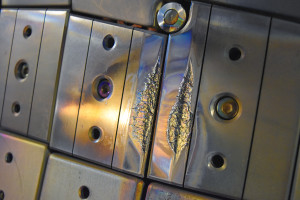
The article lists observations of damage caused by runaway impacts on past and present machines. These observations are often the result of accidents, but dedicated experiments have also been carried out, particularly in WEST. The ejection of solid debris and sometimes droplets in the case of metallic CFPs is often observed. Post-mortem analysis typically reveals severe erosion for fragile CFPs (e.g., C or BN) and melted areas with splash marks for metallic CFPs (see Fig. 1). Neutrons are produced during the interaction between runaways and CFPs, and the activation of the latter is observed, particularly on WEST. A remarkable observation is the possibility of “benign” impacts, i.e., those that do not produce any visible damage. An empirical recipe has been identified to obtain such impacts, which works on several tokamaks and is being studied as a way to mitigate the consequences of runaway beams.
Modeling these phenomena is complex and involves many aspects, from the formation of a runaway beam, through the mechanisms leading to its impact on the CFPs, to the interaction of runaways with the material within the CFPs and the resulting effects on the latter. Models have developed significantly in recent years, but further work is needed to achieve comprehensive and consistent modeling.
The prospects for ITER and other future large tokamaks are discussed. Particular attention is paid to avoiding the formation of runaway beams in these machines. Significant modeling efforts have already been made in this regard, particularly for ITER. However, the task is difficult because the mechanisms that generate runaways amplify with the size of the tokamak. It is also uncertain whether it will be possible to achieve benign impacts in ITER. It is therefore essential to estimate the consequences of runaway beam impacts on CFPs in order to optimize their design. Efforts in this direction are underway.
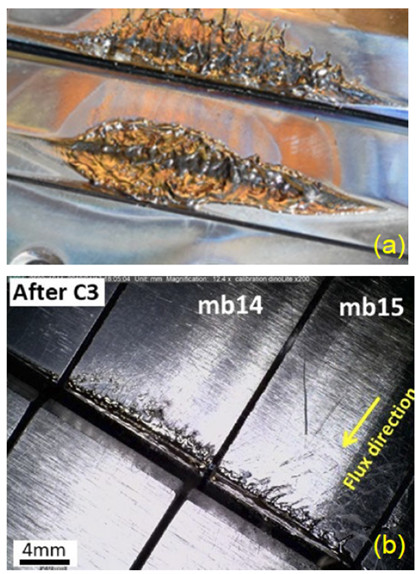
Fig. 1: Damage caused by runaways in WEST on W-shaped tiles on the low-field side of the limiter (a) and on W-shaped monoblocks in the divertor (b).