

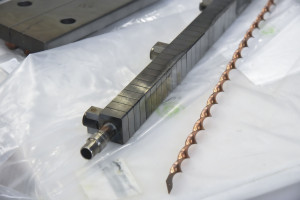
In ITER, isotopic exchange is considered a potential method for recovering tritium that becomes trapped in components facing the plasma during deuterium-tritium plasmas. This involves creating plasmas fed solely by deuterium to replace the tritium trapped in the walls with deuterium (change-over). To evaluate the effectiveness of this technique, change-over sessions were conducted in WEST, where the species injected into the plasma, deuterium and hydrogen, interact with the first wall components. By comparing simulated and experimental results, it was shown that isotopic exchange could be an effective solution for recovering tritium retained near the surface of these components.
In fusion facilities that use the deuterium-tritium (D-T) reaction, the tritium injected into the plasma can become trapped in the components facing the plasma. This retention must remain limited for safety reasons. The tritium inventory within the ITER vacuum vessel is currently limited to 700 g by the safety authority. Controlling this inventory is therefore a crucial issue, and various methods are being studied to minimize it. One of these consists of producing pure deuterium plasmas after D-T plasmas in order to recover the tritium trapped in the components facing the plasma through isotopic exchange. This method has been tested with the WEST divertor.
The latter consists of 456 actively cooled components, each comprising 35 tungsten monoblocks (Figure 1), using the same technology as those that will make up the ITER divertor. The study focuses on isotopic exchange (hydrogen, deuterium) in these components. An experimental change-over session was carried out in WEST. It consisted of producing an initial series of D plasmas, followed by a series of H plasmas, and finally ending with a series of D plasmas.
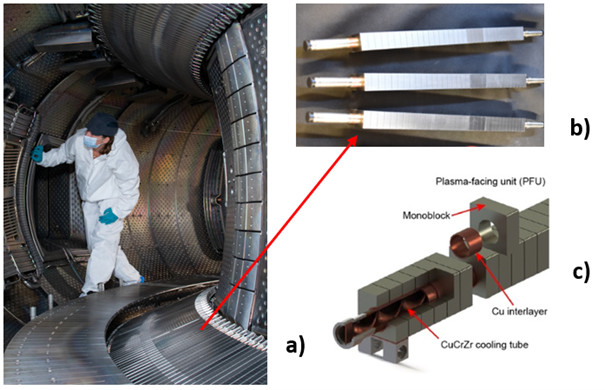
35 tungsten monoblocks (c).
To study the evolution of the H and D inventory in the divertor during this session, a representative model of the components facing the plasma under study was created using the MIHMS (Migration of Hydrogen Isotopes in MaterialS) code and interfaced with a plasma model created using SOLEDGE3X-EIRENE as described in [1], two codes developed at CEA-IRFM. SOLEDGE3X-EIRENE [2] is used to generate the exposure conditions on the divertor linked to the plasma under study. Next, the MHIMS code [3] is used to model the retention of hydrogen and deuterium in the wall during the experiment. This code also simulates the pressures associated with the degassing of H and D (H2, HD, D2).
Figure 2 shows the pressures in WEST obtained experimentally (a) and simulated (b). The simulated pressures are an order of magnitude lower than the experimentally obtained pressures, which can be explained by the absence of part of the wall in the simulations, which only concerned the divertor. However, the decay dynamics are equivalent (∝t-α with 0.7<α<1.1).
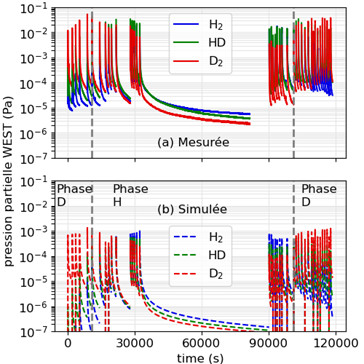
Figure 2 – Partial pressure of H2, HD, and D2
measured in WEST (a) and calculated (b)
during the inter-pulses of the change-over session
Figure 3 shows the simulated H and D inventories in the various monoblocks of the W divertor and their evolution after pure D plasmas, then H plasmas, and finally back to pure D plasmas. By summing the contributions of the H and D inventories of all the monoblocks of the WEST divertor during the experiment, the total simulated retention in the divertor is obtained, allowing the effectiveness of isotopic exchange in recovering hydrogen isotopes trapped in the components to be evaluated. After the transition to pure D, the H inventory is thus greatly reduced, with an average estimate across all monoblocks of approximately 70%. The simulations suggest that D-dominated plasmas effectively recover H trapped just below the surface (a few µm) but require more time to recover H retained at greater depths.
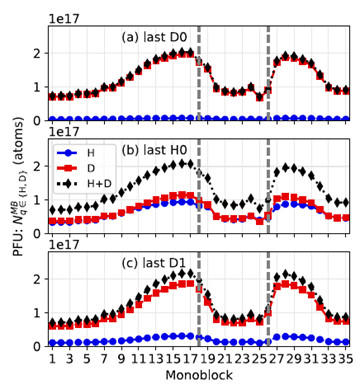
Figure 3: Simulation of hydrogen inventory (blue symbols), deuterium inventory (red symbols), and total inventory (black symbols) in the monoblocks of a WEST divertor component during change-over experiments (D0=pure D plasma, H0=H plasma, D1=pure D plasma). The gray dotted lines represent the positions of the strike points (maximum heat flux zone).
In the case of plasma using T, isotopic exchange could therefore be effective in recovering the tritium retained towards the surface.
These results, accompanied by a more detailed analysis of detritiation methods via operation in a magnetic fusion machine such as ITER, have just been published in the journal Nuclear Material and Energy [4].
[1] Denis, Bucalossi, Ciraolo, Hodille, Pégourié, Bufferand, … JET Contributors. (2019). Dynamic modelling of local fuel inventory and desorption in the whole tokamak vacuum vessel for auto-consistent plasma-wall interaction simulations. Nuclear Materials and Energy 19.
DOI 10.1016/j.nme.2019.03.019
[2] Bufferand, Bucalossi, Ciraolo, Falchetto, Gallo, Ghendrih,… the JET Team. (2021). Progress in edge plasma turbulence modelling – hierarchy of models from 2d transport application to 3d fluid simulations in realistic tokamak geometry. Nuclear Fusion 61.
[3] Hodille, Pavec, Denis, Dunand, Ferro, Minissale,… Bisson, R. (2024). Deuterium uptake, desorption and sputtering from W(110) surface covered with oxygen. Nuclear Fusion 64.
[4] Hodille, Piccinelli, Bertoglio, Loarer,…the EUROfusion Tokamak Exploitation Team.(2025). Modelling fuel retention in the W divertor during the D/H/D changeover experiment in WEST. Nuclear Materials and Energy 45.